


Nest Notes
Combining Functionality and Style: Inspiring Finished Basement Ideas

April 30, 2026
A finished basement adds an average of 500 to 1,500 square feet of livable space to a new home and recovers 70% to 75% of its cost at resale. The most popular finished basement uses include home theaters, gyms, guest suites, home offices, and wet bars. Planning the space during new construction is significantly cheaper than finishing it later. Here are 8 finished basement ideas to consider for your new home, plus what each typically costs.
Key Takeaways
- Finishing a basement during new construction costs 30% to 50% less than retrofitting later
- The average finished basement adds $30,000 to $70,000 in home value
- Most popular uses: entertainment spaces, home gyms, guest suites, home offices, and wet bars
- Egress windows, moisture control, and proper ceiling height are critical planning items
- Plan rough-in plumbing and electrical during construction even if you finish the space later
Basement Home Theater and Entertainment Room
Key design considerations:
- Dimmable recessed lighting with separate zones for viewing and walking
- Acoustic insulation in walls and ceiling to contain sound
- Dedicated 20-amp circuits and pre-wired locations for future A/V equipment
- Plush carpet or carpet tiles to absorb sound
- Built-in shelving or media wall framing for a clean finished look
Best for: Families, frequent entertainers, sports fans, and households that want a true escape from the daily flow of the home.

Basement Home Gym
A home gym in the basement gives you a private space to work out on your schedule, without commute time or membership fees. The lower level is ideal because it can handle the weight of heavy equipment and contain the noise of dropped weights or cardio machines.
Key design considerations:
- Reinforced subflooring to support heavy equipment
- Rubber or high-density vinyl flooring for shock absorption and durability
- Upgraded ventilation or a dedicated HVAC zone to manage humidity and odor
- Full-wall mirrors for form checks and visual openness
- Bright, even LED lighting to keep the space energized
Best for: Fitness-focused households, remote workers who want to build movement into their day, and anyone tired of crowded gym schedules.

Basement Creative Studio or Music Room
A finished basement makes an ideal creative space because it's naturally separated from the rest of the home, which means fewer interruptions for the artist and less noise for everyone else. It can serve as an art studio, writer's nook, podcast setup, or rehearsal space.
Key design considerations:
- Sound-dampening insulation in walls and ceiling for music or recording use
- Daylight-balanced LED lighting for accurate color work
- Built-in storage or shelving to keep tools and materials organized
- Durable, easy-to-clean flooring (LVP or sealed concrete) for art studios
- Extra electrical outlets and dedicated circuits for equipment
Best for: Artists, musicians, podcasters, writers, and side-business owners who need a quiet, dedicated workspace.

Basement Guest Suite or In-Law Apartment
A basement guest suite gives visitors a private, comfortable space and gives the household flexibility for hosting out-of-town family, adult children moving home, or aging parents. Where local ordinances allow, some homeowners also use the space for short-term rentals.
Key design considerations:
- Egress window in the bedroom (required by code for any below-grade sleeping space)
- Full bathroom with shower (rough-in plumbing during construction saves significantly)
- Separate HVAC zone for guest comfort and energy efficiency
- Soundproofing between the suite and the main living area
- Kitchenette rough-ins (water, drain, electrical) if a full kitchen is added later
Best for: Multigenerational households, frequent hosts, families with college-age kids, and anyone planning for long-term flexibility.

Basement Home Office
With remote and hybrid work now standard for many households, a dedicated home office is one of the most practical finished basement uses. The basement offers quiet, separation from household activity, and the privacy needed for video calls.
Key design considerations:
- Daylight-balanced LED lighting to reduce eye strain on long workdays
- Hardwired ethernet for reliable video calls (don't rely on Wi-Fi in a basement)
- Soundproofing if other household members will be home during work hours
- Built-in desk and shelving for an organized, clean setup
- Egress window if the office doubles as a guest bedroom
Best for: Remote and hybrid workers, side-business owners, and households where two adults work from home and need separation.
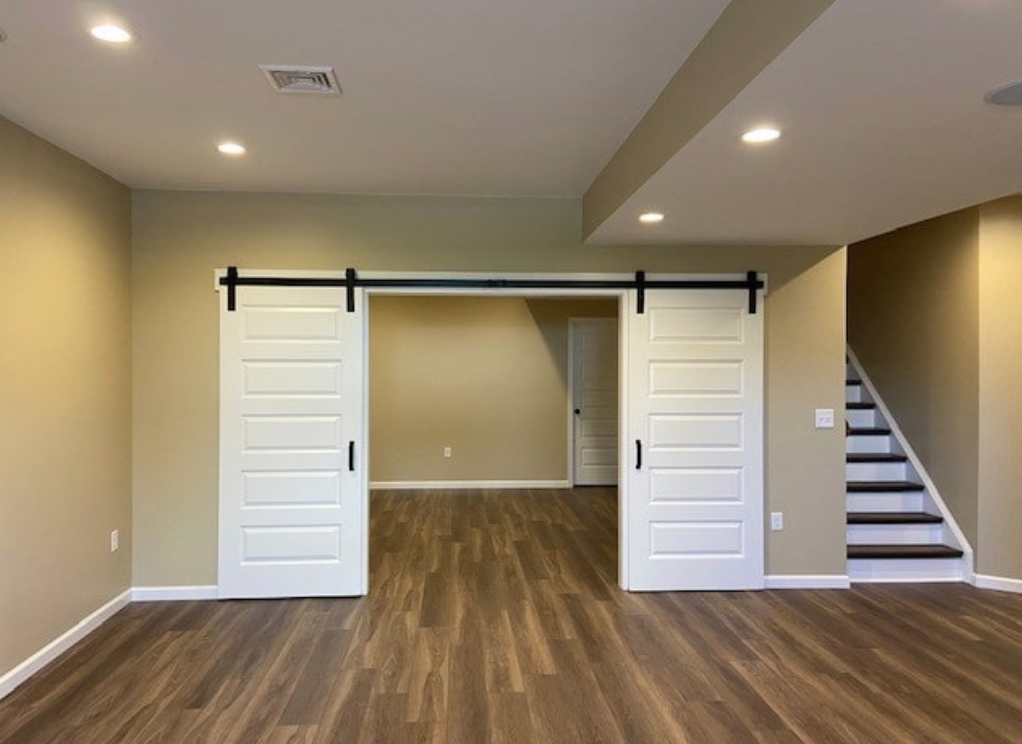
Basement Wet Bar
A wet bar makes hosting effortless and turns the basement into a true gathering space. It pairs especially well with a theater or entertainment area, so guests can grab a drink without going back upstairs.
Key design considerations:
- Plumbing rough-in for a sink and water line for an ice maker or fridge
- Dedicated circuits for appliances (under-counter fridge, dishwasher, ice maker)
- Durable countertops (quartz, granite, or butcher block) that handle spills
- Backsplash and waterproof flooring around the bar zone
- Built-in cabinetry sized for glassware, bottles, and bar tools
Best for: Entertainers, households that frequently host, and anyone who wants a defined gathering spot beyond the kitchen.

Basement Wine Cellar
The basement's naturally cooler, stable temperature makes it the ideal location for wine storage. A finished wine cellar can range from a small temperature-controlled closet to a full room with display racks and a tasting area.
Key design considerations:
- Climate control system to maintain 55-58°F and 60-70% humidity
- Vapor barrier and dense insulation to keep conditions stable
- LED lighting (which doesn't generate heat) for display and ambiance
- Custom racking sized to the collection (wood, metal, or acrylic)
- Solid-core or insulated glass door to seal the space
Best for: Wine collectors, frequent entertainers, and buyers who want a high-impact luxury feature.
Basement Playroom or Kids' Hangout Space
A dedicated kids' space gives children room to play, build, and make a mess without taking over the main living areas, and it grows with them as they move from toddler toys to teen hangouts. Many families consider this the most-used feature of their finished basements.
Key design considerations:
- Durable, easy-to-clean flooring (LVP or low-pile carpet tiles that can be replaced individually)
- Plenty of built-in storage to contain toys, games, and craft supplies
- Soft, layered lighting that works for both play and movie nights
- Scuff-resistant wall paint or wainscoting at kid height
- Open layout that can be reconfigured as kids grow
Best for: Families with young children, growing families, and households that want a defined kid zone separate from main living spaces.
Critical Planning Considerations for Finished Basements
The finishes get the attention, but the planning details below the surface are what determine whether a finished basement actually works long-term. These are the items worth thinking through before construction begins, since most are far cheaper to address during the build than to retrofit later.
Egress Windows and Building Code Requirements
Any basement room used as a sleeping space must have an egress window, which serves as a secondary escape route in case of fire. Under the International Residential Code (IRC) followed throughout Pennsylvania, the window must have a minimum opening of 5.7 square feet, an opening height of at least 24 inches, an opening width of at least 20 inches, and a sill no higher than 44 inches off the floor. Egress windows in below-grade walls also require a properly sized window well with a ladder if it's deeper than 44 inches.
Even if you don't plan to use the basement for bedrooms initially, installing egress windows during construction is far cheaper than cutting through a foundation wall later. Budget $2,500 to $5,000 per egress window during a new build.
Ceiling Height
Most Pennsylvania municipalities require a minimum finished ceiling height of 7 feet for habitable basement space, measured from the finished floor to the lowest point of the ceiling (including beams, ductwork, and pipes). Some municipalities allow lower clearance under structural beams or ducts, but never below 6 feet 4 inches.
If you're planning to finish the basement, ask your builder for a poured foundation tall enough to deliver 8 to 9 feet of finished ceiling height. The extra pour cost during construction is modest, but the difference in how the space feels is significant. Low ceilings make even a well-designed basement feel cramped.
Moisture and Waterproofing
Moisture is the single biggest threat to a finished basement. Even small amounts of water intrusion can damage drywall, ruin flooring, and cause mold within months. Proper moisture management starts during construction and includes:
- Exterior waterproof membrane applied to the foundation walls
- Perimeter drainage system (French drain) along the footing
- Sump pump with battery backup, ideally with a secondary pump
- Vapor barrier between the foundation and any framed walls
- Properly graded soil that slopes away from the foundation
- Gutters and downspouts that discharge at least 6 feet from the house
Once the basement is finished, a whole-basement dehumidifier (set to 50% relative humidity) helps maintain conditions year-round and protects everything from drywall to electronics.
HVAC and Ventilation
Basements have different heating, cooling, and humidity needs than the rest of the house, which is why a separate HVAC zone is strongly recommended for any finished basement. A separate zone allows independent temperature control, prevents the upstairs from overcooling when you're using the basement, and improves overall efficiency.
If a separate zone isn't possible, at minimum the basement should have its own thermostat-controlled dampers and dedicated supply and return ducts. Bathrooms and kitchenettes need exhaust fans vented to the exterior. Plan for these during framing, since adding ductwork to a finished space requires opening walls and ceilings.
Electrical Capacity
A finished basement adds significant electrical load (lighting, outlets, appliances, HVAC, entertainment equipment) that the main panel may not have capacity for. In most new construction with a finished basement, a sub-panel is installed in the basement to handle the additional circuits. This makes future modifications easier and keeps the main panel from becoming overloaded.
Other electrical planning items to discuss with your builder:
- Dedicated 20-amp circuits for kitchens, wet bars, and heavy-use rooms
- Hardwired smoke and carbon monoxide detectors on every level
- GFCI protection for bathrooms, wet bars, and any spaces near plumbing
- AFCI protection for bedrooms and living spaces
- Pre-wired ethernet drops in offices, home theaters, and gaming spaces (basement Wi-Fi can be unreliable)
Insulation and Soundproofing
Insulation in a finished basement serves two purposes: thermal comfort and sound control. For thermal performance, rigid foam board against the foundation walls (rather than fiberglass batts) prevents condensation and improves energy efficiency. For the ceiling between the basement and main floor, mineral wool or specialized acoustic insulation dramatically reduces noise transfer in both directions.
This matters most if the basement will be used as a home theater, music room, gym, or guest suite. Add in resilient channel or a double layer of drywall on the ceiling for premium sound isolation. Soundproofing is one of the most regretted skipped upgrades when basements are finished without it, since adding it later means tearing out the ceiling.
How Much Does It Cost to Finish a Basement in Pennsylvania?
The cost to finish a basement in South Central Pennsylvania typically ranges from $30 to $75 per square foot, depending on the scope of work, finish level, and whether the work is done during new construction or as a later renovation. For a standard 1,000-square-foot basement, the total cost is in the range of $30,000 to $75,000.
Within that range, here's what you can generally expect:
- Basic finish ($30 to $40 per sq. ft.): Open layout, drywall, standard lighting, LVP or carpet flooring, no bathroom or kitchenette. Suitable for a simple rec room, playroom, or home office.
- Mid-range finish ($45 to $60 per sq. ft.): Multiple defined rooms, upgraded flooring, recessed lighting, a half bath, basic built-ins, and quality trim work. Suitable for most family-use scenarios.
- High-end finish ($65 to $75+ per sq. ft.): Full bathroom, wet bar or kitchenette, premium flooring, custom built-ins, designer lighting, soundproofing, and high-grade finishes. Suitable for guest suites, in-law apartments, and entertainment-focused spaces.
Plan Your Finished Basement With Garman Builders
Ready to explore the possibilities for your basement? Whether you dream of a home theater, a private office, or a guest-ready suite, we’ll help you design a finished space that reflects your lifestyle and complements your home. Reach out to us today and let’s talk about how your basement can be more than just square footage. It can be a meaningful part of the place you call home.
Frequently Asked Questions About Finished Basements
Do finished basements add to your home's square footage for appraisal?
In Pennsylvania, finished basement space is typically reported separately from above-grade square footage on appraisals, not added to the total. However, it still adds significant value, usually recovering 70% to 75% of its cost at resale. A properly finished basement also makes the home more competitive against comparable listings.
What's the ROI on a finished basement?
Finished basements typically return 70% to 75% of their cost at resale, according to Remodeling Magazine's Cost vs. Value Report. ROI varies by feature: guest suites and full bathrooms tend to return the most, while highly specialized spaces like wine cellars or recording studios return less because they appeal to fewer buyers.
Do basement bedrooms need egress windows?
Yes. Under the International Residential Code followed in Pennsylvania, any basement room used for sleeping must have an egress window. The window must provide at least 5.7 square feet of opening, with a minimum opening height of 24 inches, width of 20 inches, and a sill no higher than 44 inches from the floor.
What is the minimum ceiling height for a finished basement?
Most Pennsylvania municipalities require a minimum finished ceiling height of 7 feet for habitable basement space. Some allow lower clearance under beams or ductwork, but never below 6 feet 4 inches. For comfortable usability, aim for 8 to 9 feet of finished ceiling height, which requires planning during the foundation pour.
How do you prevent moisture in a finished basement?
Moisture control starts during construction with exterior waterproofing, perimeter drainage, a sump pump with battery backup, and a vapor barrier behind framed walls. After finishing, a whole-basement dehumidifier set to 50% relative humidity protects against humidity damage. Proper exterior grading and gutters that discharge well away from the foundation are also essential.
Can you put a full bathroom in a basement?
Yes, and it's one of the most valuable additions you can make. A full-basement bathroom typically adds $15,000 to $25,000 to the cost of new construction. If the basement is below the main sewer line, an ejector pump is required to pump waste up to the sewer line. Rough-ins during construction save significantly versus adding plumbing later.
How long does it take to finish a basement?
Finishing a basement typically takes 6 to 10 weeks, depending on scope. Projects with bathrooms, wet bars, or custom-built-ins can take 12 weeks or more.
Do you need a permit to finish a basement in Pennsylvania?
Yes. Pennsylvania requires building permits for finishing a basement, with separate permits typically required for electrical, plumbing, and HVAC work. Permit requirements and fees vary by municipality. When finishing the basement during new construction, your builder handles all permitting as part of the overall project, which is one of the practical advantages of building it in from the start.
How much does it cost to finish a basement in a new home?
In South Central Pennsylvania, finishing a basement during new construction typically costs $30 to $75 per square foot, or $30,000 to $75,000 for a 1,000 square foot space. Cost depends on finish level, whether you add a bathroom or wet bar, and how the space is divided. Open layouts with standard finishes fall at the lower end.
Is it cheaper to finish a basement during construction or after?
Finishing during construction is significantly cheaper, typically 30% to 50% less than retrofitting later. The crew, equipment, and materials are already on site, you avoid the disruption of a second project, and the cost can be rolled into your primary mortgage rather than financed separately at higher interest rates.


 0
0